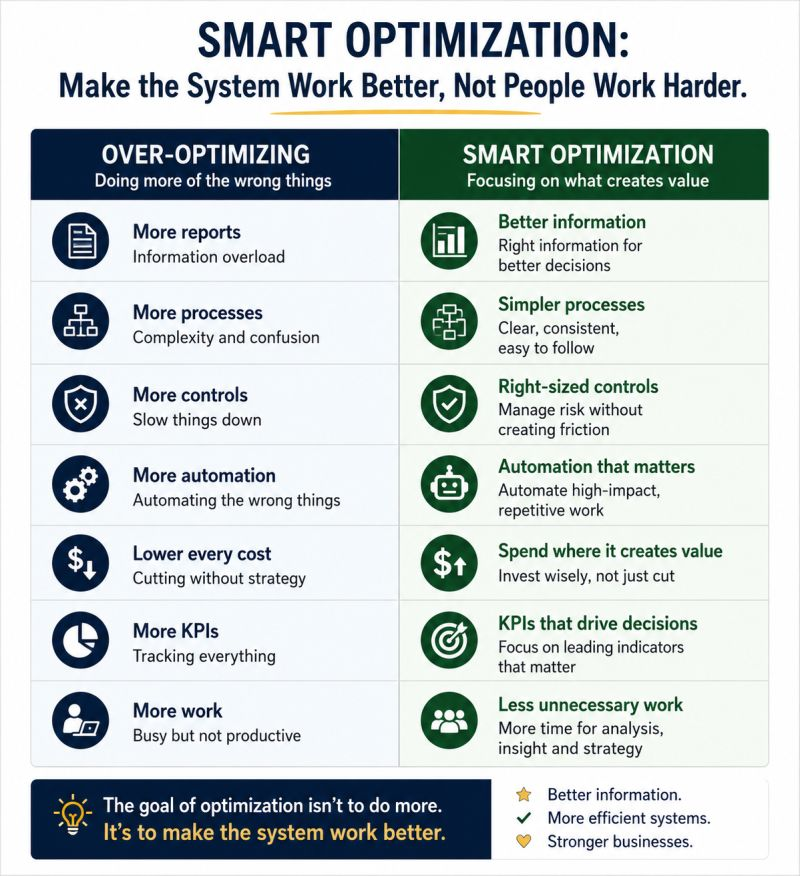
One thing I’ve realized about myself after nearly 30 years in finance:
I genuinely enjoy optimizing things.
Give me a complicated process, a messy spreadsheet, a system with too many workarounds, or a finance operation that takes too much effort to get the right answer—and my brain immediately starts asking:
Why are we doing it this way?
Do we really need this step?
Can this be automated?
Is there a simpler way?
Sound familiar?
But before jumping into optimization, you need to be clear about what you’re trying to achieve.
Maybe the goal is:
→ A process that used to take days now takes hours.
→ A confusing report becomes something leadership can actually use.
→ A team stops fighting with the system and starts using it.
→ People spend less time on repetitive work and more time on things that matter.
So, how do you get there?
Sometimes it means redesigning a process.
Sometimes it means simply connecting systems that aren’t talking to each other.
Sometimes it means eliminating a report nobody actually uses.
And sometimes, the biggest improvement is simply making sure people have the right information at the right time.
That’s one of the parts of being a CFO that I’ve always found especially rewarding.
I don’t just like working with numbers.
I like making the system behind the numbers work better.